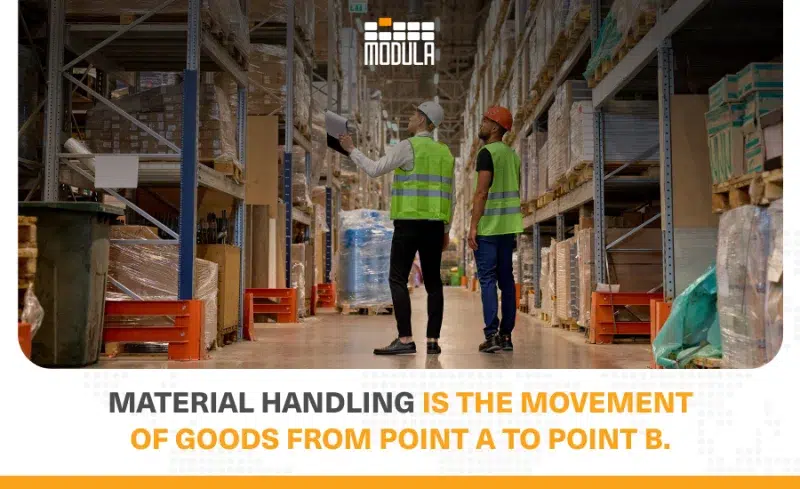
Materials Handling: Key Points
- Materials handling involves the transportation of materials and goods from point A to point B
- Materials handling provides standardised handling and transportation methods from manufacturing to distribution
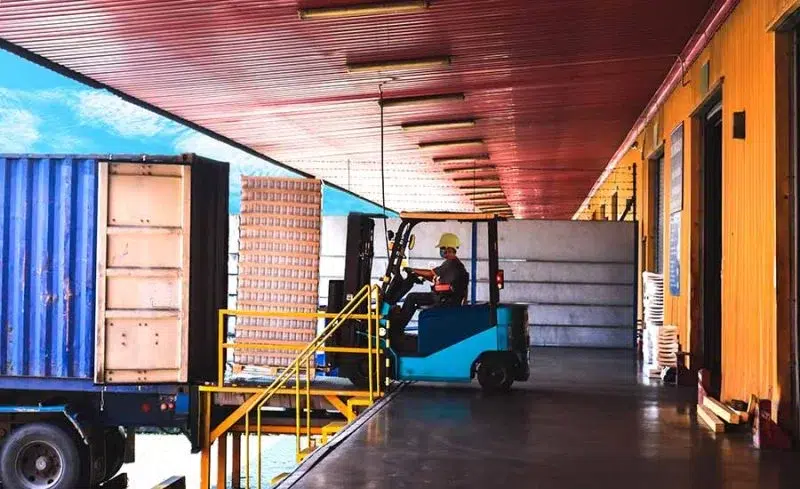
- A common example of material handling is using forklifts to raise and transport heavy loads
If you’re looking to optimise your operational efficiency and safety, understanding materials handling is essential.
Moving, storing, controlling, and protecting materials and goods throughout their lifecycle are all part of materials handling.
Widely used across different sectors, particularly in warehousing, materials handling is essential for securely storing, retrieving, and shipping goods.
In this guide, we will:
- Discuss the different types of equipment used in material handling
- Explore the benefits of incorporating material handling solutions into your warehouse
- Share insights into how our automated solutions enhance the efficiency of warehouse operations by fitting seamlessly into the material handling strategy
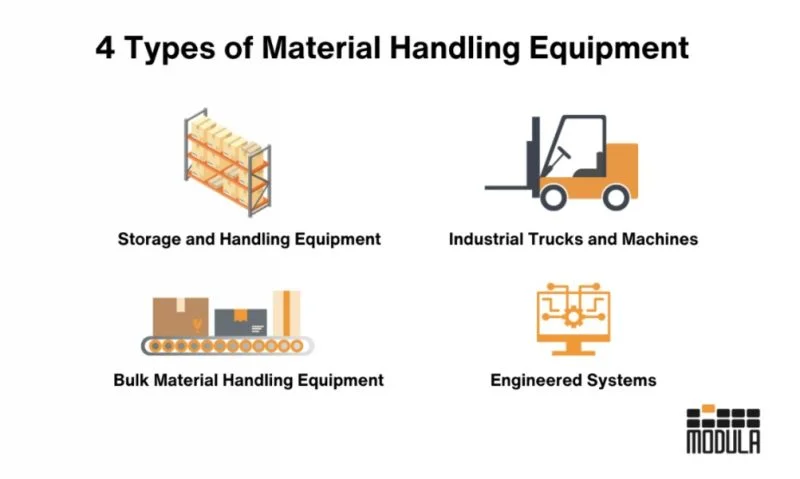
Types of Material Handling Equipment
Material handling equipment encompasses any machine or tool used for transporting, processing, storing, or packaging materials.
In warehouses, material handling equipment ranges from manual to semi-automated and automated systems to facilitate the efficient movement and storage of materials.
1. Storage and Handling Equipment
Storage and handling equipment, the most fundamental of the four categories, is essential for storing products as inventory.
This type of equipment optimises space usage, especially vertical and floor space.
They include the following:
- Bins and drawers: Ideal for small to medium-sized items, bins have open tops for quick access, while drawers provide high-density storage and often use space more efficiently than shelving.
- Storage containers: Commonly known as shipping containers, these are available in various sizes and are typically used to store large items or substantial quantities of materials.
- Storage racks: Similar to shelving units, storage or pallet racks make efficient use of vertical space with multiple horizontal platforms. Drive-in racks, which accommodate forklifts for loading pallets, maximise storage space but can limit accessibility.
- Mezzanines: These semi-permanent structures add an extra level between the floor and ceiling, increasing the usable space in a warehouse for additional work areas or storage.
- Pallets: Specifically designed for storing packaged loads, pallets enable easy movement and transportation with the help of industrial trucks or pallet jacks.
- Pallet stacking frames: You can attach these frames to pallets to enable vertical stacking of palletised loads, further saving space when not in use.
2. Industrial Trucks and Machines
These machines facilitate the loading and transportation of materials. They range from manual devices, such as hand trucks, to motorised equipment like forklifts.
- Pallet jacks: Available in manual and electric versions, pallet jacks usually transport one to two pallets at a time and have a maximum load capacity of about 5,500 pounds, with high-capacity models also available.
- Order pickers: These machines elevate warehouse workers to retrieve orders from high shelves. Generally, they have a load capacity of about 3,000 pounds and can lift up to 32 feet.
- Forklifts: Standard warehouse forklifts typically handle loads up to 5,000 pounds and can lift items 10 to 15 feet high. Larger models can manage significantly heavier loads.
- Side loaders: Side loaders are unique due to their side-mounted forks, making them perfect for narrow aisles by allowing loading operations without needing to turn the cab.
- Walkie stackers: Walkie stackers, which are operated from behind and lack a cab, function similarly to pallet jacks. They usually have a load capacity ranging from 2,000 to 4,000 pounds and can lift items between five and 10 feet.
3. Bulk Material Handling Equipment
Bulk material handling equipment efficiently moves, loads, and processes large quantities of items, from small parts like grain or rocks to larger items like furniture and appliances.
- Bucket elevators: Bucket elevators, also known as grain legs or grain elevators, are designed to transport flowable bulk materials vertically. They’re typically used in agriculture for moving materials like fertiliser.
- Bulk-handling cranes: These cranes are equipped with a two-piece hinged grab, enhancing basic crane designs to lift and manage bulk cargo such as coal or mineral ore.
- Conveyors: These systems move and process materials in bulk, using belts and pulleys to transport items from one point to another.
- Dump trucks: Designed to transport and unload large volumes of materials, dump trucks are frequently used in construction for removing debris or transporting loose materials.
- Hoppers: Common in agricultural settings, hoppers transport and unload bulk products like grain and corn through compartments at their base.
- Silos: These tall, cylindrical containers are used for high-volume storage of materials like coal, woodchips, or animal feed.
Stackers and reclaimers: Working in tandem, stackers gather bulk materials such as ore or coal, while reclaimers transport these materials onto conveyors for transportation.
4. Engineered Systems
Engineered systems are fully automated and strategically designed to decrease the need for manual labor.
Commonly leveraged in manufacturing and warehousing settings, these systems seamlessly integrate a variety of technologies to enhance operational efficiency.
- Automated storage and retrieval systems (ASRS): These are advanced robotic systems that automatically place and retrieve materials from designated storage locations. They follow the goods-to-person principle.
- Automated guided vehicles (AGV): Often referred to as self-guided vehicles, AGVs operate independently by following specific guidelines such as marked lines or wires embedded in the floor for navigation.
- Autonomous mobile robots (AMRs): More sophisticated than AGVs, AMRs use sensors to map and adapt to their environments, enhancing their navigational capabilities.
- Palletisers: These systems automate the process of stacking items on a pallet, eliminating the need for manual loading. Once loaded, the pallets are transferred onto conveyors for further processing.
- Sortation systems: These systems automatically identify items and sort them into designated locations based on specific criteria.
- Warehouse robots: Designed specifically for warehouse operations, these robots automate simple, repetitive tasks such as product retrieval from shelves.
Factors To Consider When Choosing the Right Material Handling Equipment for Your Warehouse Needs
Here are key factors to consider when selecting suitable equipment:
1. Your Operational Needs
Evaluate the types and characteristics of materials your facility handles, such as size, shape, and weight. Consider your operation’s requirements, including load capacity, height restrictions, and maneuverability needs.
2. The Environment
The environment in which material handling equipment operates—whether indoor, outdoor, temperature-controlled, wet, or corrosive—significantly influences your choice of equipment.
For example, equipment used outdoors must be durable enough to withstand weather conditions such as rain, snow, and extreme temperatures.
On the other hand, material handling equipment for indoor use, especially in temperature-controlled environments, should prioritise maneuverability and density to easily navigate through narrow aisles and doorways while protecting sensitive inventory.
3. Volume and Throughput
Analyse the volume of materials and the speed at which you need to move them. This can help you decide whether to opt for manual, semi-automated, or fully automated solutions.
4. Flexibility and Scalability
Assess equipment flexibility to ensure it can handle a variety of tasks and adjust to changes in operational scale.
Easily adjustable equipment aligns with both current and future needs, providing exceptional long-term value.
5. Safety Features
Prioritise safety by selecting equipment with built-in safety features that meet industry standards, such as emergency stop buttons, guards, and sensors to prevent accidents.
6. Ease of Maintenance
Examine the maintenance demands of the equipment. Opting for equipment that’s easy to maintain and repair reduces downtime and lowers long-term costs related to expensive parts or labor.
For example, choosing a conveyor system with modular components allows for the quick replacement of parts like belts or motors
7. Cost
Consider the total cost of ownership, including maintenance, operating costs, and potential downtime expenses, as well as the initial purchase price.
8. Consult with Professionals
Engage with material handling experts or vendors for insights and recommendations tailored to your specific needs and challenges.
They can also provide valuable advice on streamlining your workflow, enhancing safety protocols, and even predicting future needs based on industry trends.
Key Benefits of Streamlined Material Handling
Refining your material handling operations brings several significant benefits:
- Prevents workplace accidents: Implementing proper safety measures and equipment significantly decreases workplace accidents and injuries. This protection ensures employee safety and minimises downtime and associated costs, such as workers’ compensation claims, legal liabilities, and loss of skilled labor.
- Improves employee satisfaction: Efficient material handling systems and equipment simplify tasks and lessen manual labor for employees. This boosts their overall job satisfaction and morale, which in turn leads to higher productivity and retention rates.
Cut costs: Efficient material handling reduces waste, cuts operational costs, and enhances inventory management. By optimising storage space, preventing product damage, and improving workflow efficiency, you can achieve long-term savings.
How Modula APAC’s Warehouse Solutions Improve Your Material Handling Workflow
At Modula APAC, we revamp material handling with cutting-edge automated storage and retrieval systems (ASRS).
Our sophisticated systems enhance precision and efficiency, improve worker safety, and decrease the need for extensive storage areas.
Vertical Lift Modules
Transform your warehouse operations by optimising vertical space with three different configurations of our Modula VLMs:
- Modula Lift: The Modula Lift maximises warehouse space by recovering up to 90% of the floor area, triples work efficiency, and increases picking precision to nearly perfect levels.
- Modula NEXT: This system features a specially designed bay that opens only for the selected compartment during the picking process, virtually eliminating errors or the loss of items and significantly enhancing warehouse productivity.
- Modula Slim: Perfect for storing small parts and loose materials, the Modula Slim efficiently handles items like containers—including bins, boxes, cartons, and cases—as well as bottles and coils.
Warehouse Management System (WMS)
Revamp your warehouse’s productivity, accuracy, and efficiency by integrating our automated storage systems with advanced software solutions.
These solutions enhance control of inventory tracking, material handling, process analysis, and provide preventive maintenance guidance.
Our smart solutions facilitate operations in multi-order and batch modes, significantly increasing productivity while ensuring the integrity of the order fulfillment process for unusually large orders.


