
How To Improve Order Picking Accuracy: Key Points
- Most operations aim for an order picking accuracy rate between 96% and 98%
- Arrange inventory to reduce travel distances between frequently demanded items
- Create efficient picking paths to decrease redundant movements
An accuracy rate of 96%-98% is generally seen as the benchmark for effective order picking. If your business achieves this range, further improving your accuracy can give you a competitive edge.
You can do so by strategically arranging inventory, evaluating product velocity, and choosing the correct picking strategy, among others.
In this article, we will:
- Discuss the common challenges that affect order picking accuracy
- Provide tips and tricks on how to improve order picking accuracy
- Explore how Modula APAC’s Vertical Lift Modules (VLMs) can improve your order processes
Common Issues With Order Picking
Before implementing solutions, it’s essential to understand how common order picking problems can impact overall warehouse efficiency and accuracy.
Some frequent challenges include:
- Incorrect item location: Goods may be mislabeled or misplaced, leading pickers to the wrong locations.
- Mispicks due to human error: Fatigue, distraction, or oversight can cause pickers to select the wrong items or quantities.
- Lack of picking prioritisation: Without a structured system to prioritise orders, pickers may handle tasks inefficiently, causing delays and increased handling time.
- Reliance on paper-based systems: Paper picking lists are prone to data entry errors and may contain outdated information.
- Labor-intensive processes: Manual picking can be physically demanding, reducing productivity and increasing the risk of mistakes over time.
How To Improve Order Picking Accuracy
Order picking accuracy (OPA) measures how precisely staff select and prepare items for shipment in warehouses or distribution centres.
This metric plays a critical role in supply chain management and logistics, directly influencing customer satisfaction, return rates, and overall operational efficiency.
Implementing one or more best practices can significantly improve picking accuracy, increase productivity and throughput, and reduce cycle times across operations.
1. Organise Inventory Strategically
Arrange inventory to minimise travel time between frequently picked items. Implement zoning strategies where similar items are grouped together, making them easier to locate and pick.
2. Establish a Receiving Process
Implement a comprehensive receiving and inspection process to improve shipment visibility and scheduling.
Strengthen communication with dock staff by clearly outlining shift expectations, setting firm delivery times with shippers, and establishing defined time-to-unload targets.
Thoroughly inspect, sort, classify, and stage goods for immediate replenishment or storage. This approach helps maintain continuous, delay-free order fulfillment, prevents dock congestion, and boosts overall throughput.
3. Analyse Product Velocity
Track and examine the frequency and volume of picked items to prioritise their placement within the warehouse.
Position high-velocity items closer to packing stations to reduce travel time and boost picking efficiency.
4. Establish Picking Routes
Develop optimised picking routes to decrease backtracking and overlap among pickers. Efficient routes can significantly speed up the picking process and minimise potential errors.
5. Maintain Accurate Inventory Data
Keep inventory records constantly updated and accurate. Employ warehouse technologies like barcode scanning and RFID systems to track inventory levels and locations in real time.
6. Analyse Error Data
Regularly review and analyse picking errors to identify patterns and common issues. This analysis can pinpoint areas for improvement and training needs to prevent future mistakes.
7. Select the Right Picking Strategy
Choose the right picking strategy based on your order volume, as it can directly impact efficiency and accuracy. For large volumes, try batch or zone picking to simplify orders and speed up order fulfilment.
8. Establish Order Accuracy Rate Goals
Without clear direction, order accuracy rates may decline or be overlooked as a key metric.
Start by identifying your current order accuracy rate, then set realistic improvement goals and timelines. For example, if your current accuracy is at 90%, aim to increase it to 95% within the next six months.
If you have a team, clearly communicate these goals and each member’s role in boosting accuracy.
9. Leverage Bins, Totes, and Dividers
Use reusable plastic bins, totes, and dividers to organise inventory on shelves, racks, or automated systems, speeding up item retrieval.
Ideal for small items like nails and washers, these containers maximise warehouse space and lessen search times. In addition, proper labelling ensures quick access and protects contents from dust and grime.
10. Enhance Ergonomics with Goods-to-Person Technology
To enhance warehouse safety, install cushioned floor mats in areas where employees stand for long periods, improve training on proper lifting techniques, and store frequently picked items at waist height.
11. Employ Light-Directed Technology
Integrating light-directed or voice-directed picking systems enables operators to retrieve items quickly and accurately.
Light systems, such as pick-to-light and put-to-light modules, guide pickers using flashing alphanumeric codes and buttons.
Voice systems instruct pickers in their native language, further streamlining the process.
12. Consult Your Staff
Ask your warehouse workers to identify bottlenecks in the picking process, such as inefficient layouts, inadequate shelving, or outdated technology that slows down operations.
Include other supporting employees such as office administrators and equipment operators in these discussions.
13. Avoid Mixing Multiple SKUs in the Same Bin Location
Don’t store multiple SKUs in the same bin location. In many warehouses, a single shelf level holds up to ten different SKUs, requiring employees to sift through various products to locate the correct item.
14. Accomplish Lean Principles
Apply lean principles and conduct regular Gemba walks — a key component of lean management, similar to Management by Walking Around (MBWA).
By observing warehouse processes firsthand, you can gain a deeper understanding of operations and identify inefficiencies within the facility.
15. Streamline Pick Density by Grouping Popular SKUs
Strategically store high-demand SKUs together to increase local pick density. For example, grouping popular items — such as items A, B, and C — can reduce travel time and improve picker efficiency.
This setup allows order pickers to complete more picks within a concentrated area, minimising walking distance and increasing overall productivity.
16. Automate Your Processes
Incorporate automation technologies such as conveyor belts, automated guided vehicles (AGVs), and robotic picking systems to reduce human error and accelerate the picking process. Automation also ensures more consistent and reliable picking.

How To Calculate Your Order Picking Accuracy Rate
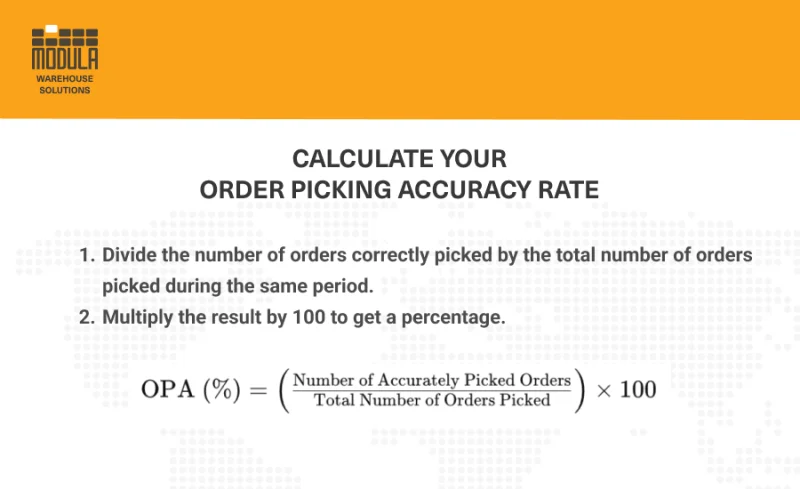
Order picking accuracy (OPA) measures how often your shipments contain the correct items. Calculating OPA helps identify error-prone processes and implement corrective actions to meet this key performance indicator (KPI).
To calculate OPA:
Divide the number of orders correctly picked and verified before shipping by the total number of orders picked during the same period. Multiply the result by 100 to express it as a percentage.
How VLMs Improve Order Picking Accuracy
Vertical lift modules (VLMs) can significantly enhance order picking accuracy through several key mechanisms:
- Space optimisation: By utilising vertical space, vertical lift modules condense storage areas more efficiently, allowing pickers to locate items quickly and accurately.
- Automated storage and retrieval: VLMs automate the process, minimising human error by delivering the correct item directly to the access window.
- Better inventory control: Integrated warehouse management systems in VLMs tracks and updates inventory levels in real time, giving pickers accurate information on SKU availability and location.
- Promotes ergonomic benefits: VLMs present items at an optimal height, reducing physical strain and allowing workers to maintain focus and accuracy without distractions from physically demanding tasks.
Reach out to us to discover how VLMs can transform your warehouse operations and boost order picking accuracy.
Order Picking Accuracy: FAQs
What is order accuracy?
Order accuracy gauges how closely shipped items match customer orders, serving as a key metric for assessing the effectiveness and reliability of the order fulfilment process.
Order picking accuracy vs. order accuracy
Order picking accuracy and order accuracy are related but distinct concepts.
Order picking accuracy specifically measures the accuracy of the picking stage, calculating the percentage of error-free picks.
On the other hand, the order fulfilment and delivery process involves multiple stages — picking, packing, labeling, shipping, and last-mile delivery — each susceptible to potential errors. Order accuracy evaluates precision throughout all these stages.
Why is order picking accuracy important?
High order picking accuracy is crucial, as it directly enhances customer satisfaction, lowers return rates, and cuts down on additional shipping costs due to incorrect orders.


