Logistics and Supply Chain Management: Key Points
- Logistics focuses on a specific set of activities within supply chain management, primarily aiming to deliver goods to customers efficiently
- Supply chain management encompasses a wide range of activities, including production and inventory planning, labor planning, materials and facilities management, manufacturing, and delivering goods and services
- Logistics and supply chain management enable companies to monitor and manage the movement of goods and services efficiently, further maximising profitability
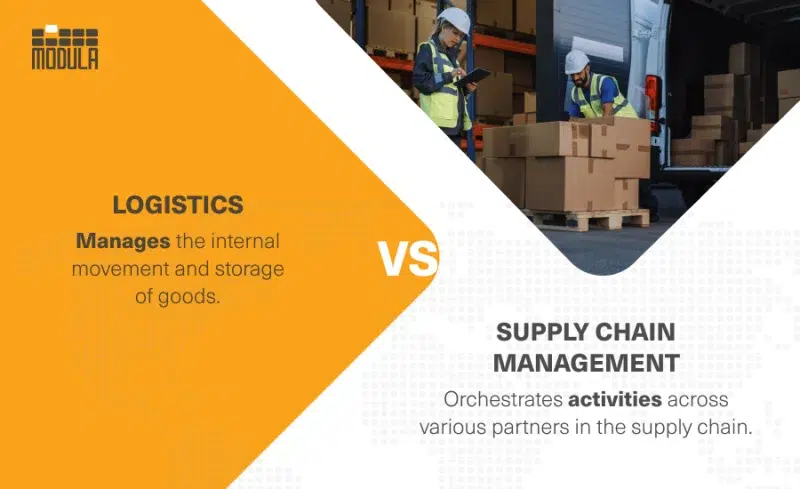
Logistics and supply chain management share many similarities, yet they’re distinguished by key differences.
Understanding these distinctions and the unique roles each plays allows companies to boost operational efficiencies, enhance customer service, and gain a competitive edge.
In this article, we will:
- Differentiate logistics and supply chain management
- Highlight their importance in your warehouse operations
- Introduce advanced solutions from Modula APAC to position your operations for success
Logistics and Supply Chain Management: Key Differences
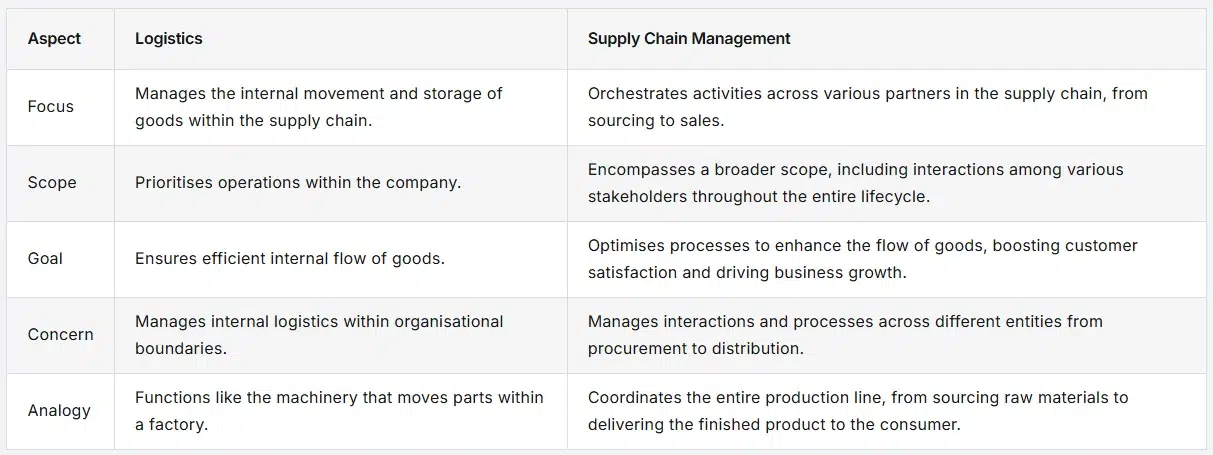
Here are the key differences between logistics and supply chain management in a nutshell:
Why Are Logistics Essential to Supply Chains?
Logistics involves planning, implementing, and controlling the efficient flow and storage of goods, services, and information from origin to consumption.
Effective logistics ensure seamless inventory movement while maintaining quality, compliance, and customer satisfaction.
Key contributions include:
- On-time delivery: Ensures the right products arrive at the right place and time
- Cost optimisation: Balances transportation, inventory holding, and operational costs
- Customer experience: Boosts retention and loyalty with high fill rates, accurate order fulfilment, and prompt responsiveness
- Competitive edge: Offers unique services such as same-day delivery, product customisation, or sustainable shipping options
- Network strategy: Optimises facility locations and transportation modes to reduce lead times and lower costs
- Visibility and risk mitigation: Leverages real-time data to forecast disruptions and facilitates swift corrective measures
- Sustainability and reverse logistics: Decreases environmental impact and manages returns effectively for value recovery
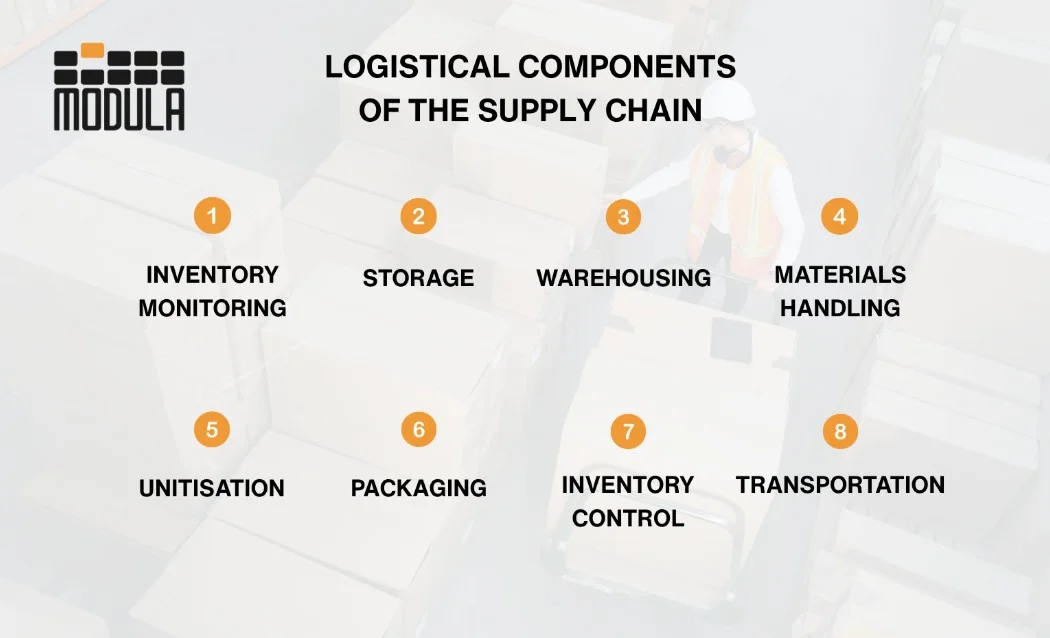
Core Logistical Components of the Supply Chain
- Inventory monitoring: Efficient tracking of item status and supply chain activities is crucial as it informs business decisions at every stage. For example, if retail managers can see inventory levels in real-time, they can tailor marketing strategies and discount offers to clear out excess stock or boost orders to fill gaps.
- Storage: Making sure that the right amount of supplies are maintained at ideal locations prevents surplus and shortages.
- Warehousing: This involves overseeing daily operations related to item movement, including coordination of logistics routes, timing, and delivery methods.
- Materials handling: This area covers the storage, security, and item movement through the manufacturing, distribution, and delivery stages.
- Unitisation: This process combines several smaller shipments into one larger shipment to increase transportation efficiency, lower costs, and optimise handling.
- Packaging: Effective packaging protects goods from damage during transit and helps minimise shipping costs by streamlining package size and materials.
- Inventory control: This incorporates storage and warehousing tactics to control the inventory type and quantity. Techniques like just-in-time (JIT) are used to cut back on holding costs and limit excess inventory by aligning production schedules with sales forecasts.
- Transportation: Manages item movement using various transportation modes, including trucks, trains, planes, and ships, while selecting the most efficient routes and methods to ensure timely delivery.
Logistics and Supply Chain Management Explained
Logistics is a component of the supply chain that focuses on strategically coordinating, enforcing, and managing the transport and storage of goods and services to meet consumer demands.
The purpose of logistics is to ensure that customers receive the correct product — at the right time and place and with the best quality and price.
Logistics and supply chain management (SCM) involves overseeing the effective flow and storage of goods and services from their origin to destination.
Both logistics and SCM manage incoming goods, inventory control, transport, storage, and distribution, aiming to ensure that products are delivered accurately and timely to the intended recipients.

Enhance Your Logistics and Supply Chain Management With Modula APAC’s Warehouse Management System (WMS)
A warehouse management system (WMS) is an advanced software that allows companies to oversee and coordinate daily operations in a warehouse, from the arrival of goods and materials until dispatch.
Modula APAC’s advanced warehouse management system is designed to optimise logistics, supply chain management, and warehouse operations, so you can focus on expanding your business and increasing ROI.
- Accurate inventory: A warehouse management system (WMS) precisely tracks each part from receiving to shipment. It offers real-time insights into inventory levels, order statuses, and overall productivity.
- Better space utilisation: A WMS strategically assigns storage locations based on factors such as item size, weight, and demand, thereby taking advantage of warehouse space and cutting back on overhead costs.
- Improved labor productivity: A WMS efficiently directs warehouse staff to the best pick locations, reducing travel time and enhancing picking efficiency. It also prioritises tasks and aligns them with worker availability.
- Enhanced demand forecasting: With integrated analytics and reporting capabilities, a WMS enables warehouse managers to identify trends, predict changes in demand, and make well-informed decisions regarding inventory management.
- Lower operational costs: A WMS can help lower overall operational expenses by decreasing labor demands and preventing mispicks that can lead to returns or additional shipping charges.
- Regulatory compliance and documentation efficiency: A WMS streamlines compliance with industry regulations by recording inventory movements and automating the generation of essential shipping and customs documents. This reduces the likelihood of manual errors and cutting down on labor-intensive tasks.


